


Bitloria markets itself as a U.S.-based crypto trading platform backed by a parent institution founded in 2015. However, its domain was only registered in late December 2025, entity records are hard to verify, and key product, fee, and platform details remain unclear. Its FinCEN MSB listing is not a crypto license or regulatory approval, and low traffic plus limited contact information point to notable transparency gaps.
What Bitloria Claims vs. What Can Be Verified
The “U.S.-Based Platform” Narrative
Bitloria describes itself as a U.S.-based digital asset exchange extending from a parent company with financial experience dating back to 2015. Its messaging highlights secure system architecture and a global token economy layout, aiming to expand into cross-chain services, payment systems, and asset management modules.
In the digital asset industry, these statements are not unusual. The key issue is whether a platform can support its positioning with consistent, verifiable details such as legal entity clarity, operational history, product disclosures, and compliance scope.
Why the Claim Matters for Users
A platform that markets itself as “U.S.-based” typically implies it can be traced through official channels, and that its entity identity is verifiable beyond marketing language. When public records cannot clearly support the claim, users lose an important reference point for accountability, dispute handling, and risk evaluation.
Domain Timeline Signals a Clear Consistency Gap
Whois Results Show a Very New Website Footprint
According to WHOIS data, Bitloria’s domain bitloria.us was registered on December 20, 2025, and last updated on December 25, 2025. This is a very recent timeline for a platform that emphasizes a parent company foundation in 2015 and “over ten years of experience.”
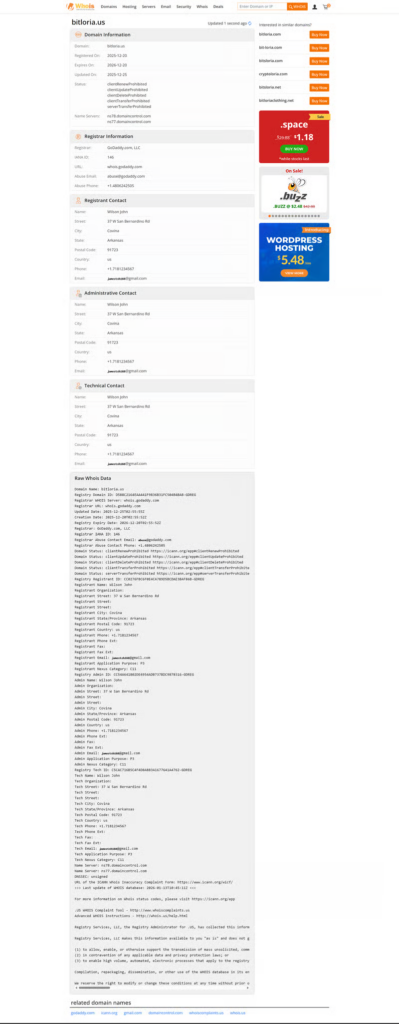
A domain registration date cannot prove when a company was founded, but it can reflect how long the official public website has existed. For trading platforms, the website is usually the primary entry point for onboarding, deposits, and service documentation, so the gap between brand narrative and domain timeline is a detail worth noting.
What This Means in a Due-Diligence Context
When a platform uses long-history language while its public-facing official website appears newly created, external observers have fewer ways to confirm past operations. This mismatch often becomes a signal that further verification is needed before users treat the brand as established.
Product Coverage Remains Broad and Undocumented
Trading Varieties Are Only Described in General Terms
Current public information indicates that Bitloria provides cryptocurrency-related trading, but it does not publicly disclose a detailed list of supported assets or trading structure. There is no clear breakdown showing whether the platform supports derivatives, stablecoins, leveraged products, or other structured instruments.
Because the product information is limited, outsiders cannot assess how complete the platform’s trading system is, or whether risk parameters and trading rules are defined in a transparent way.
Lack of Detail Makes Comparisons Difficult
Most established exchanges publish core trading information to help users understand what is actually offered, how fees work, and what trading restrictions exist. When a platform does not provide these basics, it becomes difficult for users to compare it with standard industry benchmarks.
Trading Terminal and System Architecture Are Not Publicly Explained
No Verified Trading Interface or Tooling Details
Bitloria has not provided public information about its trading terminal, mobile app availability, or API access. It also does not clarify whether the system is self-developed or relies on third-party infrastructure, nor does it present screenshots or feature demonstrations that would allow users to evaluate usability and reliability.
This makes the trading experience largely unpredictable prior to account usage, especially regarding execution conditions, asset custody flow, and platform stability.
“Technology-Driven” Positioning Lacks Supporting Evidence
Bitloria heavily emphasizes security and technological strength, but these claims are not supported by visible documentation such as a system overview, security structure explanation, audit disclosure, or product-level demonstrations. Without supporting materials, the technology narrative remains difficult to verify.
Entity Verification Signals Do Not Strongly Support “U.S.-Based” Positioning
Corporate Registration Records Were Not Found in Colorado
According to the provided information, Bitloria or Bitloria Exchange-related company registration records were not found in the Colorado Business Database. This weakens the transparency of the platform’s corporate identity and makes it harder to verify legal responsibility through official channels.
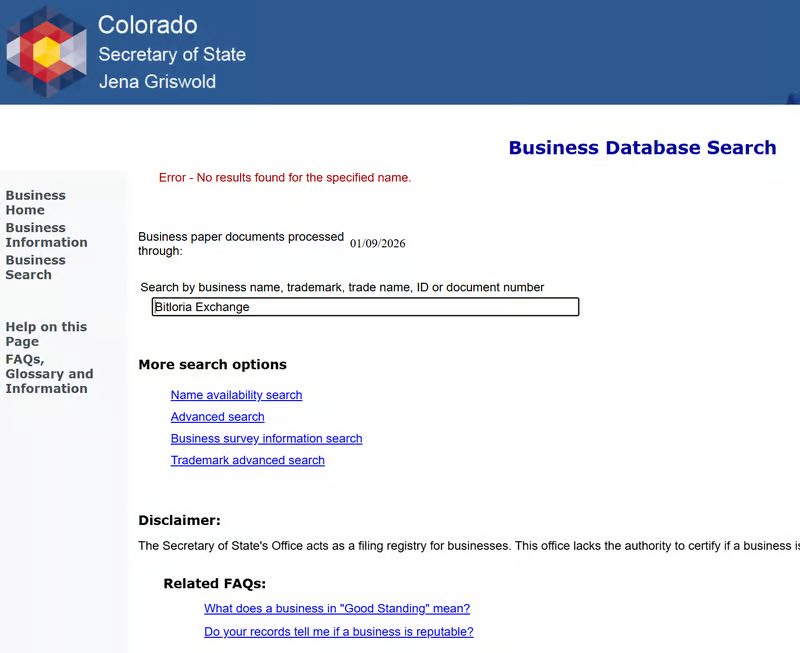
When a platform’s entity information cannot be matched reliably, users cannot cross-check the most basic operational facts such as registered name, incorporation status, management details, and official address records.
Why This Matters to Users
In financial services, the ability to confirm entity identity is one of the most important safeguards. If a dispute occurs involving deposits, withdrawals, account access, or service interruption, a missing or unclear entity match reduces the user’s options for formal verification and follow-up.
FinCEN MSB Record Exists, But It Is Not a Crypto Trading License
Bitloria Does Not Publicly Show Exchange-Regulatory Licenses
Bitloria’s official site does not clearly display recognized regulatory licenses for operating a cryptocurrency exchange. However, according to the information provided, Bitloria Exchange can be found in the FinCEN MSB register.
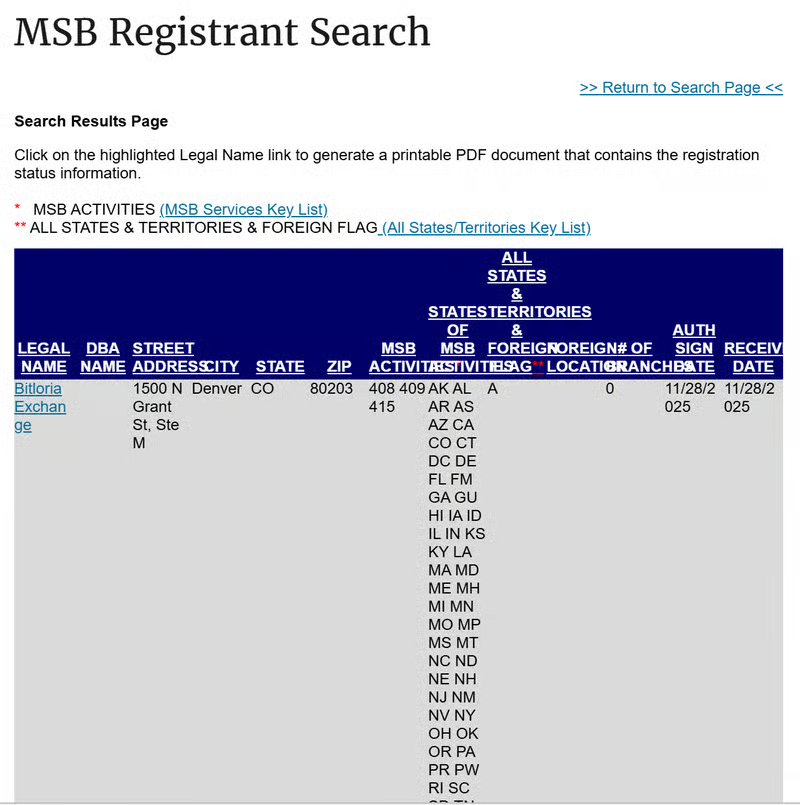
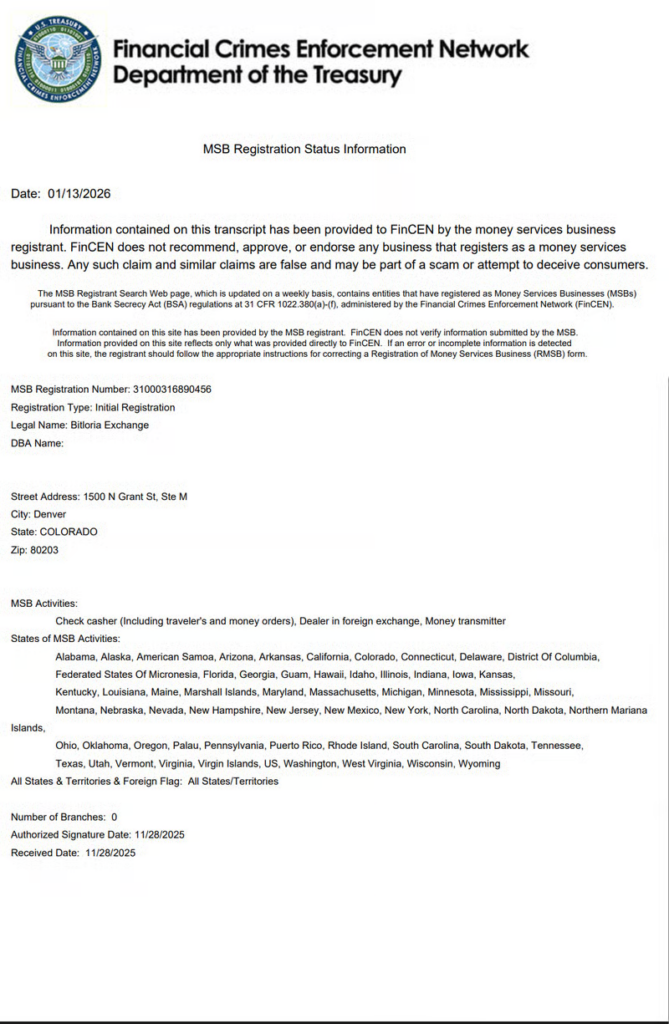
This creates a situation that requires careful clarification, because MSB registration is often misunderstood or used in a promotional way by some platforms.
The Practical Meaning of MSB Status
MSB registration is a compliance registration under the U.S. anti-money laundering framework, focusing on AML and counter-terrorism financing requirements. It does not mean the platform is approved as a cryptocurrency exchange, and it does not function as an investor-protection license.
FinCEN has also clarified that MSB registration does not equal endorsement or official approval. If a platform implies that an MSB record represents regulatory authorization for global crypto trading services, that interpretation can be misleading.
Why the Regulatory Match Looks Incomplete
Even if an MSB record exists, it does not confirm the platform’s operating model, trading infrastructure safety, or investor protection mechanisms. When the platform also lacks clear entity registration matching and product disclosures, the regulatory narrative becomes difficult to align into a consistent and verifiable structure.
Traffic Signals Show Minimal Public Market Visibility
Semrush Data Suggests Near-Zero Exposure
According to Semrush data, bitloria.us shows virtually no visible traffic, an authority score near zero, and consistently minimal visits. While backlinks may exist, the platform’s online activity does not appear to translate into actual exposure or measurable user activity.
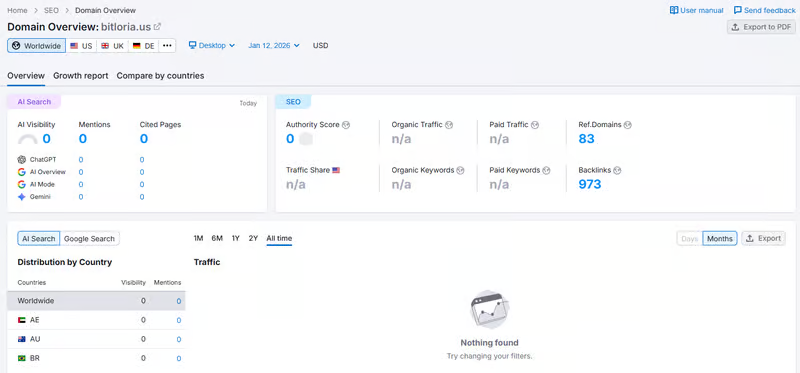
Traffic data does not prove legitimacy on its own, but extremely low visibility can conflict with broad global-user claims and makes it harder to confirm real operational scale.
Why Low Visibility Matters for Trust Signals
For platforms claiming significant user volume or a strong global ecosystem, consistent online activity is often part of the footprint. When public visibility remains extremely low, users may need additional proof before trusting statements about adoption and market reach.
Account Structure and Fee Information Are Not Transparent
No Public Account Type or Fee Framework
Bitloria has not disclosed account type differences, minimum funding requirements, or a tier structure. It also lacks clear information on fee rates, spreads, withdrawal rules, or funding parameters.
Without these details, users cannot reasonably estimate the trading cost model, understand potential restrictions, or compare Bitloria against platforms with established disclosures.
Why Fee Disclosure Is a Basic Standard
Transparent fee and withdrawal information is a practical baseline in financial services. When it is missing, users cannot evaluate whether pricing is fair, whether hidden costs exist, or whether withdrawals are constrained by unclear rules.
Contact and Social Presence Are Unusually Limited
Only One Email Contact Is Publicly Available
The only visible contact information provided is an email address, [email protected]. No public office address, support hotline, or team details were identified from the information provided.
For a platform handling financial transactions, such a single-channel contact structure makes independent verification more difficult.

No Verified Official Social Media Accounts Found
No official social media accounts for Bitloria were identified. For a platform presenting itself as global and ecosystem-driven, this absence is unusual, because social channels are typically used for platform status announcements, updates, and operational transparency.
Without public social channels, users have fewer ways to track platform changes, service incidents, or real-time operational communications.
Final Assessment: Bitloria Shows Multiple Transparency Gaps
Bitloria’s branding emphasizes technology, security, and global token-economy ambitions, but the publicly verifiable footprint shows multiple inconsistencies and missing disclosure layers. The domain timeline is extremely recent compared to long-history claims, entity matching signals are weak, and the platform offers limited visibility into products, fees, and trading infrastructure. While an MSB record may exist in FinCEN’s register, this cannot be treated as a crypto trading license or proof of regulatory approval. Combined with low traffic visibility and minimal contact channels, Bitloria currently presents a risk profile that depends heavily on claims rather than verifiable operational transparency.
FAQ
What is Bitloria?
Bitloria is presented as a digital asset trading platform that offers cryptocurrency-related services and ecosystem features.
When was Bitloria’s website registered?
Public WHOIS data shows the domain bitloria.us was registered in late December 2025.
Does Bitloria disclose its trading products clearly?
Available information suggests cryptocurrency trading is offered, but detailed product coverage and rules are not fully disclosed.
Does Bitloria provide information about its trading platform or app?
Public details about trading terminals, mobile apps, or API tools are limited.
Is Bitloria regulated?
The platform does not clearly display a crypto trading license. A FinCEN MSB record may exist, but MSB registration is not the same as regulatory approval for a crypto exchange.
How can users contact Bitloria?
Public contact information appears limited, with email being the primary channel mentioned.