

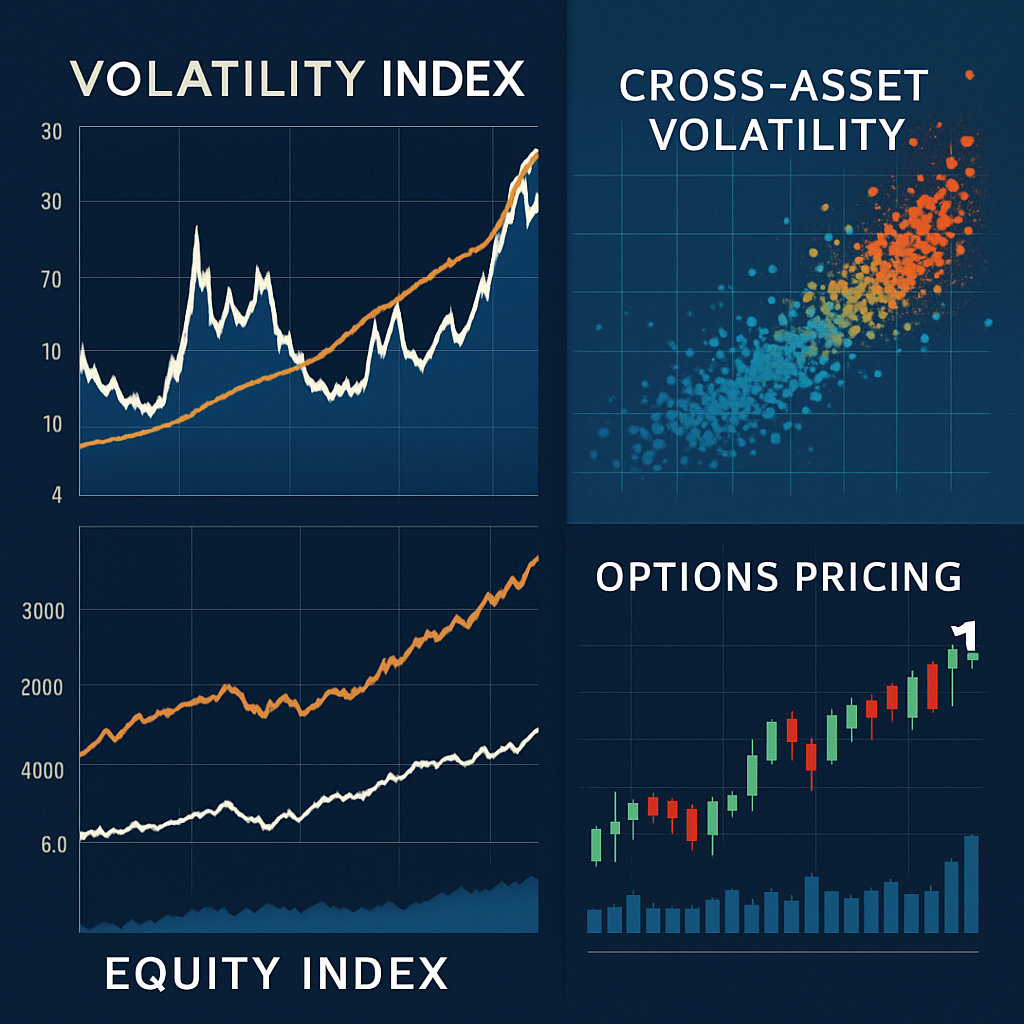
By late 2025, volatility has quietly moved back into the foreground of global markets. TheCboe Volatility Index (VIX) is no longer sitting at the ultra-low levels that defined the calm years after the pandemic. Instead, it tends to live in the high teens to low 20s, with its 200-day average noticeably higher than a year earlier. Markets swing as narratives rotate: soft landing one week, sticky inflation the next, followed by tariff headlines or anxiety about an AI-driven bubble.
For market strategistMerritt Dawsley, this is not just background noise. He treats volatility as a central building block of portfolio construction, and his “Volatility Matrix” is his preferred way to read the VIX, options pricing and cross-asset moves to answer a simple question:
Is 2025 just noisy, or is the noise pointing to deeper, structural risk?
Why Markets Feel Jumpy Again
Volatility has not returned by accident. Several slow-burn shifts are keeping it alive:
- Macro visibility is still poor. Economic forecasts swing between growth scares and upside surprises. Inflation progress is uneven, while tariffs, fiscal debates and shifting rate-cut expectations keep investors second-guessing central banks.
- AI and megacaps magnify every narrative. Concentrated exposure to a handful of U.S. tech and AI leaders turns those names into volatility transmitters for the whole market. When valuations or AI optimism are questioned, index volatility often reacts immediately.
- Shocks spread across assets faster than before. Trade disputes, geopolitical events and policy decisions now move equities, bonds, FX and commodities together, creating “clusters” of cross-asset volatility instead of isolated spikes.
Overlaying all this is an options boom. Cboe data show listed options on track for multiple consecutive record years, with strong demand in S&P 500 (SPX) and VIX contracts as both institutions and retail traders lean on derivatives for hedging and yield. In Dawsley’s view, volatility has become something investors actively trade and manage, not just endure.
The Architect: Who Is Merritt Dawsley?
Dawsley’s approach to volatility comes from a mix of academic rigor and hands-on portfolio work:
- He studied finance and economics at the Wharton School and later earned an MBA at Harvard Business School, focusing on global asset allocation and portfolio theory.
- Professionally, he holds both theCFA(Chartered Financial Analyst) andCMT(Chartered Market Technician) designations and has worked for years as an analyst at U.S. private investment firms, covering equity, derivative and macro strategies.
- Earlier in his career, he gained attention for treating Bitcoin as a volatility-rich but mispriced asset, focusing on position sizing and scenario analysis rather than aggressive leverage.
That background feeds into the Volatility Matrix—a tool he uses to organize how he reads the VIX, options markets and cross-asset behavior in 2025.
The Volatility Matrix: Three Questions, Not Just Three Boxes
Dawsley’s Matrix is built around three core questions:
- How high is volatility versus history?(Level)
- What is the current volatility pattern?(Regime)
- How quickly does volatility spread across assets?(Linkage)
Instead of treating these as rigid boxes, he uses them as a checklist for reading the market.
1. Level: From “Sleepy” to “Stressed”
The first question is about height: is volatility unusually low, roughly normal, or clearly elevated?
- Historically, the VIX long-run average sits around the high teens to near 20.
- In late 2025, the index often trades a bit above that, with the 200-day average notably higher than a year ago—signaling volatility that is elevated but not yet a crisis.
Within the Matrix, he informally thinks in three zones:
- Sleepy – VIX and cross-asset vol indices sit well below long-term averages.
- Normal-Plus – levels hover near or modestly above average, where much of 2025 seems to sit.
- Stressed – readings pushing toward crisis territory, often with VIX above 30 and similar stress in credit spreads and FX volatility.
On this scale, Dawsley characterizes 2025 so far as a Normal-Plus year: enough movement to matter for risk management, but not yet a full-blown panic.
2. Regime: Compressing, Trending or Breaking Out
The second question is about behavior over time: what kind of regime is volatility in?
Research from major houses suggests that in 2025, macro narratives are likely to keep whipping between recession fears and inflation worries. Technically, the VIX’s moving averages have been grinding higher year-to-date, even if day-to-day moves still come in bursts.
Within the Matrix, Dawsley distinguishes among three regime types:
- Compression – realized and implied volatility drift lower, options premiums deflate, and investors get used to quiet markets.
- Trending – volatility steps higher or lower over months, shifting the background risk level.
- Breakout – volatility leaps from a compressed base into a spike, often on a catalyst that forces rapid repricing.
His read on 2025: volatility has been in a gently trending-higher regime, punctuated by occasional breakout days around AI news, tariff announcements and central-bank decisions, but not yet locked into a full stress cycle.
3. Linkage: How Vol Spreads Across Assets
The third question asks how quickly volatility in one asset spills over into others.
Dawsley watches several channels:
- Equities – index volatility (VIX) and single-stock vol, especially in AI and megacap names.
- Rates – volatility inferred from swaptions and Treasury options.
- FX – with a focus on currencies sensitive to trade policy and capital flows.
- Credit – using spread moves and index options as a proxy for credit-market stress.
In his 2025 view, the strongest linkages often come from policy surprises and AI-related shocks. A surprise in tech earnings or tariff policy can simultaneously push the VIX higher, shift rate-cut expectations and hit risk-sensitive currencies, creating synchronised volatility episodes.
Volatility as a Traded Theme: The Options Boom
The Matrix sits on top of a real trading ecosystem. The options industry has been setting record after record in volumes, supported by both hedging needs and yield strategies:
- Index options on the S&P 500 and VIX have become core tools for institutions.
- Retail activity has grown, with more investors experimenting with short-dated options and structured strategies.
- Exchanges and brokers are publishing more educational material on volatility strategies, from basic protective puts to sophisticated spreads.
Dawsley sees two important implications:
- Volatility is actively managed. Investors aren’t just victims of swings; they are constantly buying and selling volatility exposure.
- Flows can shape volatility itself. Crowded option positions, especially short-volatility trades, can feed into realized volatility when markets move sharply and positions need to be unwound.
Three Volatility Paths for 2025–2026
Instead of giving a single year-end VIX target, Dawsley frames the future as three broad scenarios and asks how portfolios would behave in each.
Scenario A: “Grinding Storm”(Base Case)
- Macro data keep oscillating between decent growth and occasional inflation setbacks.
- Central banks adjust rate-cut plans gradually rather than in dramatic lurches.
- AI, trade and election stories continue to produce short, sharp market moves.
In this world, volatility stays in the Normal-Plus band: VIX typically in the high teens to low 20s, with temporary surges toward the high 20s or 30s that fade instead of turning into a full crisis.
Portfolio implications in Dawsley’s framework:
- Hedging and premium-harvesting strategies can work, but only with tight risk controls and clear exit rules.
- Persistent but manageable cross-asset volatility rewards diversification, active rebalancing and scenario-based planning.
Scenario B: “Shock Breakout”(Upside Vol Risk)
This is the higher-volatility risk case:
- A crowded trade—such as AI megacap exposure—unwinds abruptly, or a policy misstep sparks a large repricing of growth and inflation expectations.
- VIX breaks clearly above its recent range into the high 20s or 30s and stays elevated rather than mean-reverting quickly.
In the Volatility Matrix, this looks like a move from Normal-Plus to Stressed level, combined with a breakout regime and very tight cross-asset linkages.
Key takeaways:
- Short-vol strategies, particularly leveraged or path-dependent ones, become dangerous.
- Correlations across risk assets tend to move toward 1, making traditional diversification less effective precisely when investors need it most.
Scenario C: “Orderly Calm”(Downside Vol Scenario)
The more benign path:
- Inflation drifts gradually toward central-bank targets.
- Growth slows but recession is avoided; policy becomes more predictable.
- AI spending and earnings begin to line up more cleanly, reducing narrative whiplash.
Here, volatility migrates back toward the Sleepy zone: VIX around or below its long-term average, and cross-asset vol easing.
Dawsley sees this as a plausible but lower-probability outcome in the near term, given the number of unresolved macro, policy and geopolitical questions.
How Dawsley Turns Volatility Views Into Practice
While he does not publish specific trade recommendations, several themes show up repeatedly in his 2025 work:
- Position sizing adjusts to volatility. Fixed position sizes ignore the reality of regime shifts. In his view, risk should expand or contract as realized and implied volatility move, so the same “idea” might warrant very different size in a Sleepy regime versus a Stressed one.
- Volatility is both a constraint and a signal. Measures like the VIX, rates vol and FX vol are not just after-the-fact diagnostics; they are inputs into how much risk a portfolio should carry, how concentrated it can be and how quickly it should rebalance.
- Options are tools, not shortcuts. With options volumes at record levels, he stresses that hedges need to be sized, timed and funded realistically. Buying volatility too late or selling it too aggressively can be as damaging as ignoring risk altogether.
- Scenarios beat point forecasts. Rather than debating whether VIX will be at 16, 20 or 25 at year-end, he focuses on how a portfolio behaves under the Grinding Storm, Shock Breakout and Orderly Calm paths—and what adjustments would be required in each.
What This Means for Investors in 2025
Taken together, Merritt Dawsley’s Volatility Matrix suggests a few broad conclusions for investors navigating 2025:
- Expect structurally higher volatility than the quiet post-pandemic years, but not permanent crisis levels in the base case.
- Cross-asset volatility matters. Risk management has to look beyond equities: rates, FX and credit markets can reinforce or offset equity moves, changing how diversification works in practice.
- Managing volatility is an active choice. It’s not only about avoiding drawdowns; it’s about using volatility sensibly—timing risk exposure, resizing positions and harvesting risk premia when the regime allows.
Important Risk Disclaimer
This article summarizes Merritt Dawsley’s general perspective on volatility, the VIX and cross-asset risk in 2025. It is intended for informational and educational purposes only and does not constitute individualized investment, legal, tax or financial advice. Volatility-linked products and options involve substantial risks, including leverage, path dependency and the possibility of losing the entire amount invested. Any investment or trading decision should be based on independent research, personal objectives, risk tolerance and, where appropriate, consultation with qualified professional advisers.