
The global forex market (FX market) is the most liquid market on earth, and it usually comes back to a few checkable drivers: the U.S. dollar, interest-rate differentials, and the data calendar. In early 2026, Lambes Invest frames the forex market around a simple question: is the latest USD bounce a durable trend, or a tradable swing that fades as data resets expectations?
Key, checkable signals in the forex market right now
- EUR/USD is softer, USD is firmer: Reuters reported the euro near $1.16845 on Jan 5, 2026, while the dollar index was up on the day.
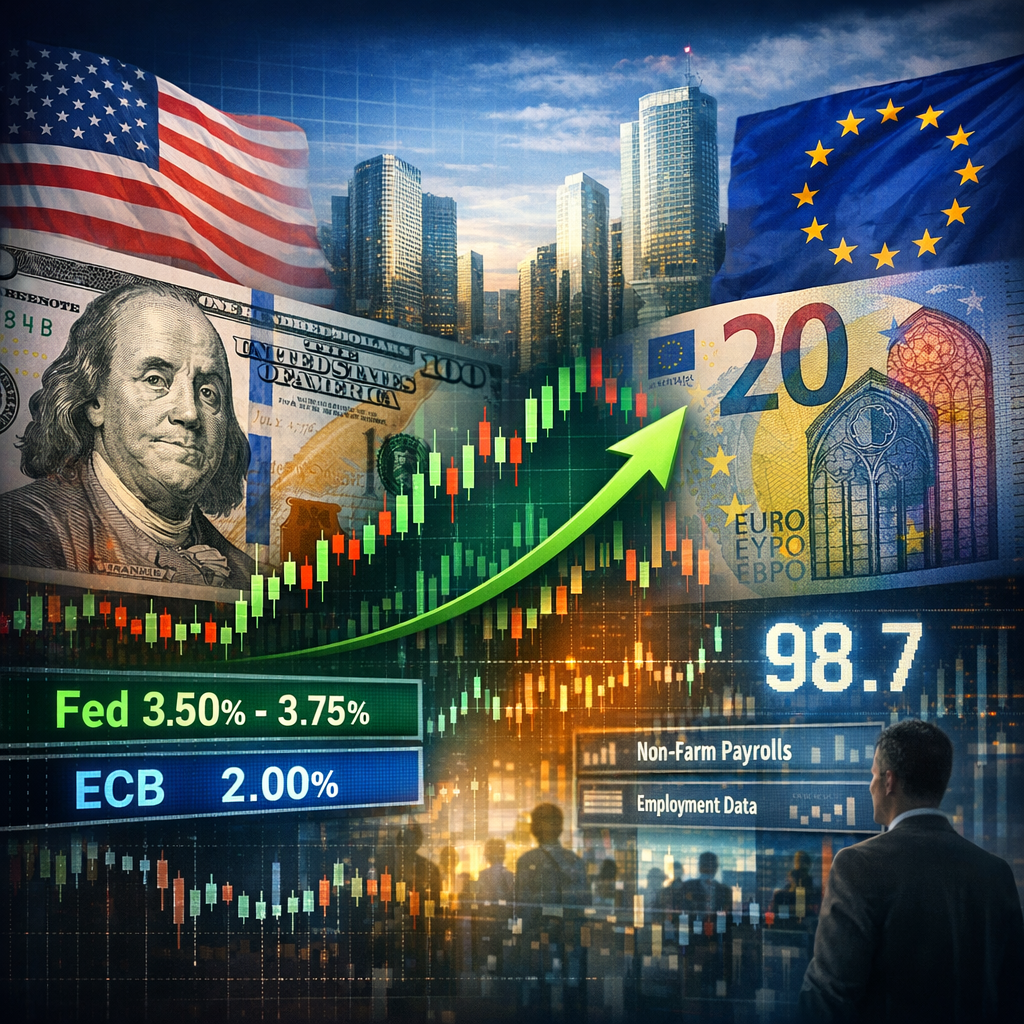
- DXY is near the high-98s: widely followed DXY historical prints show the U.S. Dollar Index around ~98.6–98.7 on Jan 5, 2026.
- The Fed policy rate is still meaningfully above Europe: the FOMC lowered the target range to 3.50%–3.75% (Dec 2025 decision).
- ECB’s deposit facility rate is 2.00%: the ECB rate table shows 2.00% effective June 11, 2025, and it remains at that level in early 2026 datasets.
- The week’s macro calendar is the near-term catalyst: Reuters highlighted ISM manufacturing early in the week and U.S. non-farm payrolls on Friday as key drivers for Fed path expectations—and therefore for the forex market.
Lambes Invest takeaway: the FX market is trading the USD narrative through the lens of “how many cuts, how fast, and how resilient is U.S. growth.”
Why the U.S. dollar matters so much in the forex market
In the global forex market, the U.S. dollar is not just another currency—it’s the primary reference point for pricing, hedging, and carry. When the market starts leaning toward “slower rate cuts,” the USD often benefits because the interest-rate differential widens (or stays wide) versus lower-yielding peers.
Right now, the differential is visible on the surface:
- Fed: 3.50%–3.75%
- ECB deposit rate: 2.00%
That gap matters because the forex market tends to reward currencies with higher carry when risk conditions are stable, and it tends to punish them when data forces repricing.
EUR/USD in early 2026: a big-market pair with clean drivers
For an “ear familiar” big market, it’s hard to beat EUR/USD. It’s the headline FX pair, and it often behaves like a live referendum on:
- U.S. data momentum vs. euro area momentum
- Fed cuts vs. ECB cuts (and the timing gap)
- positioning and volatility around major releases
With EUR/USD near 1.168–1.169 on Jan 5, 2026, the market is clearly willing to pay up for the USD when near-term macro risk rises.
Lambes Invest framing: if Friday’s payrolls (and the week’s ISM / activity data) confirm resilience, the FX market can keep supporting the dollar—not because the euro “breaks,” but because rate expectations stop falling as quickly.
The macro pipeline: the forex market’s “fuel schedule”
The forex market doesn’t need a story every day—often it needs a calendar. Reuters noted the market’s focus shifting toward a “slew of U.S. data,” beginning with ISM manufacturing and culminating in non-farm payrolls.
For Lambes Invest, this matters because big FX moves frequently come from:
- Surprise direction (data beats/misses)
- Policy repricing (cuts added/removed)
- Second-order effects (risk appetite, hedging demand, carry unwind)
In practice: the forex market can look calm until one number flips the implied path.
A practical scenario map
Scenario A — “Sticky resilience” (USD-supportive):
- U.S. data holds up; markets price fewer/farther cuts.
- DXY stays supported in the high-98s or pushes higher.
- EUR/USD remains heavy, rallies fade into resistance as carry remains attractive.
Scenario B — “Growth wobble” (USD-corrective):
- Data prints show fragility; cuts get repriced faster.
- The USD gives back gains as the forex market shifts from carry to “policy easing.”
- EUR/USD bounces—not because Europe suddenly outperforms, but because the dollar loses its rate advantage at the margin.
Scenario C — “Two-speed central banks” (range-trading FX):
- Fed and ECB both cut, but in a predictable cadence; volatility compresses.
- EUR/USD chops; the forex market rewards tactical entries more than big conviction.
Bottom line from Lambes Invest
In early 2026, Lambes Invest views the global forex market as a USD-driven, data-driven FX market: EUR/USD is trading the gap between Fed policy (3.50%–3.75%) and ECB deposit rate (2.00%), while the macro calendar (ISM → payrolls) sets the timing for repricing.
The practical message is simple: in the forex market, direction often follows rates + data + positioning. When those three line up, trends extend. When they diverge, the FX market snaps back fast.


